
In a recent workshop I facilitated, I had shared with practitioners a transcript from a therapeutic conversation with a person who had come for consultation. It was in the middle of this shared reading that someone asked me how I position myself in moments of pause.
The question landed, and I noticed myself resisting the tendency to offer a clear-cut answer. Not because I had nothing to share, but because the momentum of the group conversation seemed to invite something slower – a pause that asked for attention rather than explanation. I remember the room in that moment. The slight shuffle of chairs settling. A pen being placed back on the table. Someone shifting their weight. Eyes turning toward me, expectant but not urgent. The air did not feel empty. It felt full. As though the question had taken up space between us and was asking to be noticed before being spoken to. I could feel the familiar pull of “therapeutic authority” to respond – to offer clarity, to guide, to fill the silence with structured or linear ways of making sense. And at the same time, another pull in the opposite direction. To pause. To stay with what had just arrived. The question did not feel like it wanted an expert-driven answer. It felt like it wanted something slower than a response shaped by dominant hierarchal forces. Something closer to noticing and deconstruction.
I became aware of the quiet assumption informing the question – that silence in therapy is one thing. A single, uniform experience. A neutral space between words. And the more I stayed with that assumption, the more it seemed to call for gentle unpacking. So rather than speaking from my own practice alone, I invited the question to sit with us in the room.
I said something like, “Well… as I sit with the pause you’ve been noticing here in this transcript, I find myself wondering about other practitioners’ experience of pauses in their work. It has me thinking whether pauses are ever only an individual experience between a practitioner and a person seeking consultation. Or whether pauses and the effects of them might be more of a collective experience that shows up in our work in different shapes and nuances, across different conversations, shaped by different contexts. I’m curious about the many places pauses arrive in your own practice. Would you describe ‘a pause’ as a single-storied experience? Or, when you look more closely, might pauses be connected to multiple stories – perhaps about safety, uncertainty, liminality, power, ethics of care and collaboration, or something else entirely?
Maybe this is something we can become curious about together before I try to offer a response from my own practice?”.
You could almost feel the room lean back slightly. Pens were set down. People shifted from note-taking to reflecting. The question stopped being directed at me and began to live between us. Not something I needed to explain, but something we could become curious about together. And that’s where a new thread of co-research quietly opened for the collective.
I asked participants of the workshop about their own experience of pauses in therapeutic conversations:
- What different types of pauses do you notice in your therapeutic conversations?
- How do you come to recognize that one pause is different from another?
- What was happening in the conversation just before the pause arrived? What unfolded just after?
- When are pauses influential and contributes to the conversation? What tells you this?
- What might they get in the way of?
- What do you notice the pause doing with the space it takes up – honoring, communicating, disrupting, holding, gathering, stretching, testing, marking?
- How might we gently check with the person about their experience of the pause?
- How would you describe the position you take up with each kind of pause? Is this your preferred position? How does it have you navigating accountability?
- Are silences something you intentionally create space for, or is there a sense that they assert themselves? What moments in your conversations do you notice inviting stillness, and when do you notice silences sweeping you along, carrying the rhythm of the exchange in unexpected ways?
- Do some pauses feel invited, welcomed, or made space for? Do others feel unexpected or unplanned?
- How might we check in with the person how they want us to respond to different types of silences? How might we co-design responses collaboratively and in response to moment by moment experience?
- Which moments of pause feel the hardest to stay with, and why? What aspects of pauses feel most difficult to attend to or hold in conversation?
- How do pauses influence the pace of the conversation? What do you notice about how pace and power are connected in these moments?
- When might a pause have you less connected to ideas of collaborative practice?
- Have your own experiences of silence in your work context and life shaped how you notice, sit or respond to pauses in therapeutic conversations?
You might know this experience – when a curiosity does not end when the conversation ends. When it follows you home, sits beside you while you make dinner, circles back while you are doing something entirely unrelated, and quietly asks to be thought about again. Like a tune that keeps replaying itself, or a small stone in your pocket that you keep touching without quite realizing why. That is how my attention to pauses continued to move with me.
After the end of the workshop, I found myself returning to old session transcripts and recordings with a different kind of attunment, tracing where pauses appeared. I began noticing not only the pauses themselves, but also how I responded to them – how I adjusted and re-positioned in their presence. This led me to wonder what intentions, narrative ideas, ethics, and positionings were shaping my responses in those moments, and what effects those responses had on the unfolding of the conversation.
Gradually, it became clearer to me that in my practice, silence does not arrive with a single meaning. Silence is not one thing.
As you read this, if you pause for a moment, you might begin to notice the many types of silences you have encountered – in your work, and in the world beyond therapy, in everyday life. Perhaps you recognize the hush of a winter morning, the quiet of leaves shifting in the wind, or the particular stillness that gathers here, as your eyes rest on these words, lingering line by line with the pace of your reading.
Silence can carry multiple and diverse textures, intentions, and histories. Some are shaped in human relationships, while others come from more-than-human rhythms such as in nature, place and community/collective ethics, ideas and practices. The silences we encounter in daily life are not always the same as those that appear in therapy – and even within therapy, silences are not all of the same nature. Some are born from uncertainty, others from reflection, others from relational or ethical tensions.
In therapy, pauses often make themselves known in their own unique ways, shaping the conversation and inviting us, as practitioners, to attend to the complexities and edges of our commitment to a “decentered and influential” position.
In supervision, practitioners and I have been attuning to how pauses make themselves present in such conversations, noticing how they unfold and are shaped together with the people they are meeting. Some silences feel warm, like a shared exhale between practitioner and person, interrupting the problem-saturated urgency to «fix», or the forward momentum of interrogation-style questioning and structured scientific approaches, offering instead more circular ways of moving together in conversation. In these moments, pauses become part of a slow-paced co-research that is quietly influential and political – resisting linear movements and refusing to be recruited into dominant ideas of progress, speed, or outcomes.
Some feel sacred, holding something that is waiting to be spoken. Some interrupt a linear or clinical telling, or quietly unsettle established ways of knowing and speaking within the conversation. Some pauses holds at their heart multiple bodies of ancestral, spiritual, political and philosophical knowledges keeping us accountable to make space for subjugated voices, presences and experiences. Some emerge as an agentic act, creating moments where the person and practitioner can negotiate direction, space, choice and consent together. Some shift the space between people, moving attention subtly and creating relational distance. Some gather participants closer, like the stillness at the heart of a ritual or a (definional) ceremony. And some stretch the space between moments, opening room for witnessing and re-positioning within the conversation.
Here, I want to linger with two types of silence that I have become particularly attentive to in therapeutic conversations: what I have come to call the «span pause» and the «threshold pause».
Sometimes, I find myself meeting a silence that has arrived after a question travelled too far, came too quickly, or not quite fitted with what was unfolding in the conversation. It is as if the question has moved beyond where the person can easily stand, and the silence comes forward in its place – not as absence, but as a quiet signal that the distance was misjudged.
And in those moments, silence can carry a kind of weight. A risk. It can quietly reproduce familiar and painful territories of “not knowing,” prompting thoughts and feelings like these in the person themselves:
- I should know how and what to respond.
- I can’t recall aspects of my life I should be able to remember or have noticed.
- I’m not offering the right answer.
- I’m not contributing enough to the conversation.
- I’m failing here too.
A gap begins to open between the knowledge the persons feel they are supposed to have and the knowledge they believe is required to “adequately” participate in the relational co-construction of knowing in the conversation.
And I am implicated in that.
Not just as an individual therapist, but as someone shaped by – and moving within – discourses of expertise. Of knowing. Of asking the “right” question.
The way I experience pauses in these moments between my question and the person’s response is like a signpost, letting me know that my invitation at the moment might need to be offered in a different way – in smaller scaffolded questions, or more experience-near questions – to make meaning-making more accessible for the person I am working with. This is the kind of pause I call “the span pause”.
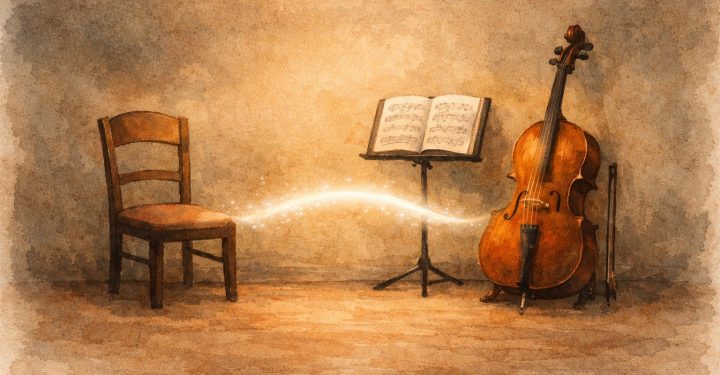
When Lev Vygotsky wrote about the Zone of Proximal Development, he was describing a kind of distance I came to know very well through the years I studied the cello. I don’t play anymore. I stopped after working many years in the conservatoire. But my body still remembers how learning used to happen there.
When I was learning a new passage, I never began by playing it at full tempo from start to finish. That would have been too far from what my hands could manage – my fingers would stiffen, the bow would lose its contact with the string, and frustration would arrive quickly. But I also couldn’t stay only with passages I could already play with ease. Nothing new would have been learned there.
So I did something very particular.
I slowed the music down.
I took two bars.
I played them at half speed.
I repeated them until my fingers began to recognize the shape.
Then I joined four bars.
Then I added the bowing.
Then I increased the tempo slightly.
Then I placed it back into the whole piece.
Each step sat just beyond what I could do comfortably – close enough that my body could reach toward it, far enough that something new was being asked of me.
Without knowing it at the time, I was scaffolding my own learning with my teacher’s assistance. This is what Vygotsky was pointing to. Learning does not occur in what is already mastered, nor in what feels impossible. It occurs in this responsive in-between space, where the stretch is carefully held.
For me, scaffolding came to feel like a practice of attunement:
- noticing when the task was too familiar,
- noticing when it was too overwhelming,
- and adjusting the distance so the next small step could be taken.
Two bars.
Four bars.
A phrase.
The whole passage.
Until one day, the music had quietly taken up residence in my hands.
So in moments of pause in therapeutic conversations, silence is not neutral.
It is telling me something about the distance between my question and the person’s lived experience of receiving that question.
The work then becomes less about waiting for an answer… and more about how I reposition myself within this liminal space of silence in ways that close the gap and meet the person «where they are» in their articulation of experience. And this “bringing closer” can happen in several ways.
Sometimes, a question I have offered is carrying too much complexity, being inclusive of multiple stories. It may be trying to hold together more than one lines of enquiry eg the effects of the problem, preferred responses, relationships, values, and context in a single invitation. In these moments, scaffolding means In these moments, scaffolding means making the question smaller by locating it in one particular aspect of the person’s experience that has already been named.
Instead of asking:
“How does this affect you, and who around you helps you deal with it?”,
I might separate into:
“What does this tend to do to your life when it shows up?” (effects)
and later,
“Is there anyone who tends to be nearby, or comes to mind, when this is happening?” (supportive figures)
The scope narrows. The proximity increases.
At other times, the question may be stretching across both problem-saturated and preferred stories in ways that feel too wide for the person to step into. Scaffolding then involves separating these territories, allowing the person to stand more firmly in one before moving toward the other.
Instead of asking:
“How did you respond differently to this compared to how things used to be?”
I might first ask: “What usually happens when this shows up?”
and only later: “Was there anything, even slightly, that didn’t follow that usual path?”
Here, the movement from problem stories to alternative stories is not assumed. It is gently enquired.
Sometimes, what needs scaffolding is not the content of the question but the landscape it is located in. A question situated in the landscape of identity (“what this says about you as a person”) may feel too distant when the person is still trying to articulate what happened in the landscape of action.
So I might move from:
“What does this tell you about what matters to you?”
to “What happened next?”, “Who was there?”, “What did you do with your hands?”.
And only after dwelling there, return to:
“As you describe this, what does it begin to say about what is important to you?”
The scaffolding here is a movement between the landscape of action and the landscape of identity, paced in a way that the person can travel.
Sometimes we receive a response that feels broad or abstract, and the question we might offer in return carries several threads at once, opening up multiple possibilities for exploration. For example, a question like, “What did you do when that experience of feeling deflated came up, how did you care for that feeling, and how did you care for yourself during that time?” can leave a span pause, as the person navigates where to place their attention. In these moments, I find it helpful to treat the emerging theme as a line of enquiry rather than a single question.
We can slow down, exploring one aspect at a time: “As you spoke, I noticed you said deflated and let down… can you describe that a little more? What was it like to be engaged with deflated? How would you describe this as an image or metaphor?” From there, the conversation might gently unfold further, noticing the embodied experiences that emerge. This approach foregrounds permission-seeking, pacing, and the careful introduction of questions before fully moving into the line of enquiry: “Would it be okay if I asked a little more about your experience of deflated?” — letting the person shape, moment by moment, if and how far the enquiry travels.
One way to think about this kind of scaffolding is to bring it back to your own practice. Think of a moment when a response you received felt broad, abstract, or full of multiple possibilities for exploration. Perhaps a person offered an experience, a feeling, or a story that carried several threads at once. Now, imagine if you slowed down and treated one thread—one aspect of that response—as a line of enquiry. What might it be like to spend the session exploring just that one thread? How many questions could you ask? How many invitations to notice, describe, or reflect might emerge? As you imagine this, notice the moment-by-moment choices you would make: when to pause, when to ask permission to continue, when to linger with what has already emerged. This is scaffolding in action- giving shape to complexity without rushing toward closure, and attending to the possibilities that live within a single theme.
At other times, the distance is created not by the structure of the question, but by its language. The words I am using may belong more to intellectual vocabularies than to the person’s lived, sensory, imaginal world. Scaffolding then invites me to translate the question into the person’s images, metaphors, and local language.
If someone has described their experience as “feeling like being caught in fog,” asking about “clarity” or “understanding” may travel too far. Instead, I might ask: “What is it like to stand in that fog?”, “Can you see anything at all from where you are?”, “Is the fog thick or thin today?” The question moves from abstraction into experience-near imagery the person already inhabits.
And sometimes scaffolding is about checking in with the person about the effects of our questions: “Is this question easy or hard to sit with?” or “Should we make this smaller?”
In these ways, scaffolding is a practice of accountability. It is a continual adjustment of distance – between my question and the person’s capacity to engage with it in that moment. The «span pause» carries this distance-with-possibility, quietly signaling that the space between us can be crossed, but not yet in the way I first invited.
Just as with the cello, the “score” of the conversation does not change. What changes is our proximity to what feels possible to play.
In the next fragment, I will stay with a different kind of silence – one that does not signal distance, but something else entirely – what I have come to call the «threshold pause».
© 2026 Kassandra Pedersen. All rights reserved. No part of this publication may be reproduced, distributed, or transmitted in any form without the prior written permission of the author.


